
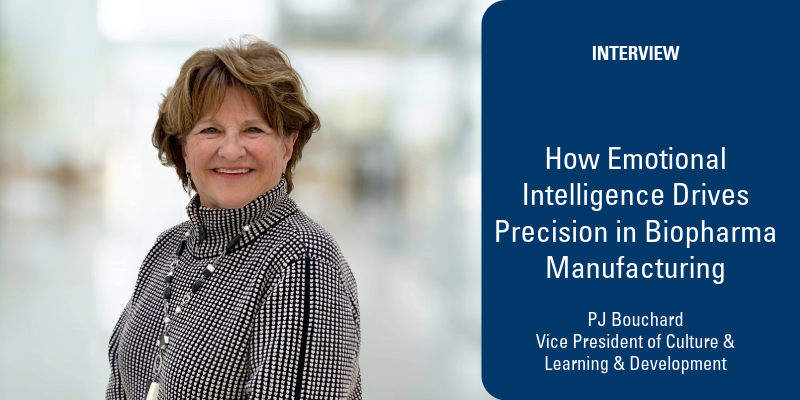
In a recent interview with Forbes contributor Kevin Kruse, Rentschler Biopharma’s Vice President of Culture & Learning & Development at our Milford, MA site, PJ Bouchard, explored a topic that is reshaping human skills in today’s workplace, emotional intelligence.
At first glance, emotional intelligence may seem far removed from a field where accuracy, consistency, and technical rigor are everything. But in biopharmaceutical manufacturing, where a single deviation can delay critical therapies, human skills can be just as essential as scientific expertise.
Decades of research reinforce this connection. When leaders build stronger emotional and interpersonal capabilities, teams become safer, more collaborative, and more effective. One study found that after supervisors were trained in competencies like active listening and constructive problem-solving, lost-time accidents were reduced by half, grievances nearly disappeared, and productivity goals were exceeded by $250,000.
At Rentschler Biopharma, a global contract development and manufacturing organization (CDMO), where more than 1,400 employees across the U.S. and Germany work toward delivering life-changing medicines, this philosophy is woven into how teams operate every day. As PJ Bouchard says, “if people don’t feel safe to speak up or make a mistake, then something is wrong with the culture.”
Bouchard’s insights shine a light on why emotional intelligence is not just a leadership trend, it’s a strategic capability that strengthens quality, safety, and performance across the biopharma landscape.
To the article (external link)

Rentschler Biopharma SE
Latika Bhonsle-Deeng, PhD
VP Global Marketing and Corporate Communications